Power Station or DIY Battery Bank? The Crossover Is the Second Battery
A house carrying its real essentials through an outage draws 7,362 watt hours a day, which works out to two 5.12 kWh battery modules for a single day without grid or sun. That number matters more than any brand argument, because two modules is almost exactly the point where buying a sealed power station and building the same thing on a battery rack cost the same. Below two modules, the sealed box wins outright. Above it, the rack pulls ahead and keeps pulling. Almost nobody tells you where that line sits, so this guide works it out.
The load behind that figure is an ordinary one: a full size refrigerator, a chest freezer, a gas furnace blower, a sump pump, a handful of LED bulbs, a router, a CPAP and the inverter's own idle draw. Everything running at once comes to 1,705 watts, with a worst case start surge of 2,905 watts when the sump pump kicks in against everything else. Run those same appliances through the load calculator on this site and you will get the same answers, because that is where these came from.
September is the month to work this out. Readers who start in November are shopping during the first storm warning, when stock is thin and nobody is thinking clearly.
What you are actually comparing
A power station is not a battery. It is a battery, an inverter, a solar charge controller, and an automatic changeover, all in one case with the wiring already done. When people say building is cheaper, they are usually comparing a sealed box against a bare battery, which is not the same purchase at all. The honest comparison puts a whole system on each side.
One difference that sounds important turns out not to be. All four options here cut over to battery within the same band, and the spread between the fastest and slowest is small enough that no appliance in the list above would notice. The published figures are 8 to 20 milliseconds on the Pecron in backup mode, under 10 on the EcoFlow, 20 on the Anker, and under 15 on the EG4 inverter. Those are manufacturer figures rather than measured ones, but they are all in the same place. Changeover speed is not the reason to pick a side.
What genuinely differs is what each path charges you to add the second, third and fourth battery.
The Pecron path
Pecron F5000LFP Portable Power Station, 5120Wh
This is the value benchmark on this page and the only sealed unit that beats a built rack at its own smallest size. It holds 5,120 watt hours, puts out 7,200 watts of AC, and carries both 120 V and 240 V without an external hub, which matters if anything in your backup plan is a 240 V load. Solar input runs to 6,400 watts across an MPPT window of 30 to 180 volts. Against the built rack at one battery it costs less and delivers more continuous output, which is a genuinely awkward result for anyone who assumes DIY always wins.
Pecron F5000LFP Portable Power Station, 5120Wh
Price as of Sep 30, 2026. Prices and availability change; check the retailer for the current figure.
Check price at Amazon →Affiliate link. We may earn a commission.The catch is the ceiling. It expands to 35.8 kWh and stops there, which is six extra modules on top of its own internal capacity.
Pecron FP5000-48V Extra Battery, 5120Wh
This is what makes the Pecron path priceable rather than a marketing number. It adds another 5,120 watt hours at 48 volts, in the same LiFePO4 chemistry, and fits the F5000LFP or the F3000LFP. Six of them reach the stated ceiling.
Pecron FP5000-48V Extra Battery, 5120Wh
Price as of Nov 4, 2026. Prices and availability change; check the retailer for the current figure.
Check price at Amazon →Affiliate link. We may earn a commission.Per kilowatt hour added, it is comfortably the cheapest way to grow a sealed system on this page, and it is the reason the Pecron stays competitive further up the curve than the other two boxes do. It is still dearer per kilowatt hour than a rack battery.
The EcoFlow path
EcoFlow DELTA Pro 3 Portable Power Station, 4096Wh
A 4,096 watt hour LiFePO4 unit with 4,000 watts of AC output and the fastest published changeover here, under 10 milliseconds. Its solar window is narrower than the Pecron's, 30 to 150 volts and 2,600 watts, so a large array needs more thought about string voltage.
EcoFlow DELTA Pro 3 Portable Power Station, 4096Wh
Price as of Nov 4, 2026. Prices and availability change; check the retailer for the current figure.
Check price at Amazon →Affiliate link. We may earn a commission.It costs more than the Pecron while holding less energy and putting out less power, and that is the plain reading of the numbers on this page. It is worth being clear about what the difference buys: EcoFlow is one of the best known names in this category, and a premium for a widely sold brand is a normal thing to pay. Whether that is worth it to you is a fair question with no universal answer, and not one published figures alone can settle.
EcoFlow DELTA Pro 3 Extra Battery, 4096Wh
The matching 4,096 watt hour module. It is the most expensive way to add a kilowatt hour of anything on this page, by a clear margin, which is the single most useful thing to know before committing to this path. If you expect to grow past one unit, that figure compounds every time.
EcoFlow DELTA Pro 3 Extra Battery, 4096Wh
Price as of Nov 4, 2026. Prices and availability change; check the retailer for the current figure.
Check price at Amazon →Affiliate link. We may earn a commission.The Anker path
Anker SOLIX E10 Home Backup System, 6kWh expandable to 90kWh
The most home shaped of the three boxes. It starts at 6 kWh, states 7.6 kW of AC output and 9 kW of solar input across a 30 to 450 volt window, which is the widest here and the friendliest to a long string of panels. Its stated expansion ceiling of 90 kWh is far beyond what the other two sealed units offer.
Anker SOLIX E10 Home Backup System, 6kWh expandable to 90kWh
Price as of Nov 4, 2026. Prices and availability change; check the retailer for the current figure.
Check price at Amazon →Affiliate link. We may earn a commission.It is also the dearest entry point on the page. As with EcoFlow, the sensible way to read that is a brand premium on an established name rather than a fault, and buyers who want the most widely supported ecosystem have a real reason to pay it.
Anker SOLIX B6000 Battery Module, 6kWh
The module that makes the 90 kWh ceiling mean something. It adds 6 kWh of LFP and states 10 kW of output. Per kilowatt hour it lands between the Pecron and EcoFlow modules, so the Anker path scales better than EcoFlow's and worse than Pecron's.
Anker SOLIX B6000 Battery Module, 6kWh
Price as of Nov 4, 2026. Prices and availability change; check the retailer for the current figure.
Check price at Amazon →Affiliate link. We may earn a commission.Building the same thing on a rack
Wiren | Server Rack Battery | 48V 100AH | U5
The cheapest energy on this page by a wide margin, and not by cutting corners: 5,120 watt hours at 51.2 volts, 100 amp hours, 100 amps of discharge, and certifications to IEC62619, UL1973 and UL9540A. That last point is not decoration. If your system will ever touch the grid rather than running fully off grid, a UL listed battery is the one your inspector will expect to see.
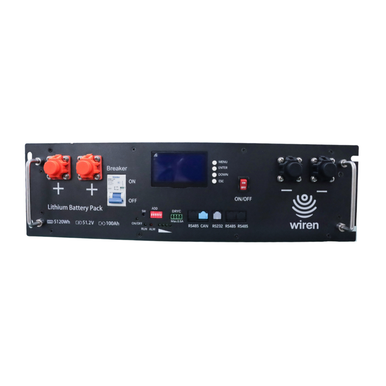
Wiren | Server Rack Battery | 48V 100AH | U5
Price as of Nov 11, 2026. Prices and availability change; check the retailer for the current figure.
Check price at Signature Solar →Affiliate link. We may earn a commission.It also lists communication with EG4, Growatt, Victron, SMA, Sol-Ark, Schneider and others, so it is not locked to one inverter brand the way every module above is locked to its host.
EG4 | 6000XP Off-Grid Inverter
The fixed cost of the rack path, and the piece you only buy once. It gives 6,000 watts continuous and 12,000 watts of surge for 3.5 seconds, carries UL1741, runs two MPPTs at 4,000 watts each across a 120 to 385 volt window, and changes over in under 15 milliseconds.

EG4 | 6000XP Off-Grid Inverter
Price as of Nov 11, 2026. Prices and availability change; check the retailer for the current figure.
Check price at Signature Solar →Affiliate link. We may earn a commission.That surge rating is the one specification on this page that none of the sealed boxes publish, and it is the number that decides whether a well pump or a compressor starts. Buying the inverter once is also the whole reason the rack wins as the bank grows: the second battery costs only a battery.
Blue Sea Systems 5502 Class T Fuse Block, 320 A
Rated to 320 amps, and the piece people forget when they price a build. A 48 volt lithium bank can deliver enormous fault current, and Class T is the fuse type that can interrupt it.
Blue Sea Systems 5502 Class T Fuse Block, 320 A
Price as of Nov 4, 2026. Prices and availability change; check the retailer for the current figure.
Check price at Amazon →Affiliate link. We may earn a commission.Read this one carefully before ordering: the block holds the fuse, and the fuse itself is a separate purchase whose rating comes from your inverter's charge and discharge current, not from the block.
What the rack price does not include
This is where honesty matters more than the arithmetic. The rack column above covers a battery, an inverter and a fuse block. A working install also needs the Class T fuse itself, a cabinet or rack to hold the batteries, busbars to tie them together, and battery cables made up to the right length and lug size. None of those are on this page.
On top of hardware, a permanent system wired into the house means an electrician, a permit and an inspection in most places. Anything touching your service panel is licensed work, and that is not a corner to cut.
Add those up and the picture at two modules, where the bare numbers show a near tie, becomes a genuine tie or slightly worse for the rack. The rack does not win decisively until about four modules, where the gap is wide enough that no cabinet or cable run closes it.
Parts list
- Pecron F5000LFP Portable Power Station, 5120Wh - sealed 5.12 kWh system with 7,200 W output and native 240 V
- Pecron FP5000-48V Extra Battery, 5120Wh - the cheapest sealed expansion here, up to six of them
- EcoFlow DELTA Pro 3 Portable Power Station, 4096Wh - 4.096 kWh, fastest published changeover
- EcoFlow DELTA Pro 3 Extra Battery, 4096Wh - matching module, dearest energy on the page
- Anker SOLIX E10 Home Backup System, 6kWh expandable to 90kWh - widest solar window, highest ceiling
- Anker SOLIX B6000 Battery Module, 6kWh - 6 kWh of expansion for the E10
- Wiren | Server Rack Battery | 48V 100AH | U5 - 5.12 kWh, UL1973 and UL9540A, cheapest energy here
- EG4 | 6000XP Off-Grid Inverter - 6,000 W continuous, 12,000 W surge, bought once
- Blue Sea Systems 5502 Class T Fuse Block, 320 A - the fuse holder the bank legally needs
Who this is for, and who should skip it
Buy a sealed box if your sizing lands at one module, if you rent or expect to move, if you want backup working the evening it arrives, or if the idea of torquing lugs on a live battery bank does not appeal. Nothing about that is a compromise. A sealed unit at one module is genuinely the cheaper answer as well as the easier one.
Build the rack if your sizing lands at four modules or more, if you want a surge rating you can look up before trusting it to a pump, if you want the battery brand and the inverter brand to be separate decisions, or if the system will grow over several years.
Skip both if you have not sized your load yet. Every number in this guide moves if your daily watt hours move, and the crossing point moves with it. Two modules for one day is this example's answer, not yours.
Bottom line
For most people sizing a first backup system, the Pecron F5000LFP Portable Power Station, 5120Wh is the one to buy: it is the only sealed unit here that costs less than building the equivalent while also putting out more continuous power, and it needs no permit, no electrician and no inspection.
Pecron F5000LFP Portable Power Station, 5120Wh
Price as of Sep 30, 2026. Prices and availability change; check the retailer for the current figure.
Check price at Amazon →Affiliate link. We may earn a commission.FAQ
Is a power station or a DIY battery bank cheaper for home backup?
At one battery's worth of storage the sealed station is cheaper and puts out more continuous power. From about two modules on, a rack built around a single inverter costs less, because the inverter is only bought once while a sealed system prices the whole unit every time.
How much battery do I need to run my house essentials for a day?
A full size refrigerator, chest freezer, gas furnace blower, sump pump, LED lights, router and CPAP came to 7,362 watt hours a day in this example. At one day of autonomy, 80 percent depth of discharge and 90 percent inverter efficiency, that is two 5.12 kWh modules.
Do I need a Class T fuse for a 48V lithium battery bank?
Yes. A 48 volt lithium bank can deliver very high fault current and Class T is the fuse type rated to interrupt it. Note that the holder and the fuse are separate purchases, and the fuse rating comes from your inverter's charge and discharge current rather than from the block.
Does a power station switch over to battery faster than a DIY inverter?
Not by enough to matter. The published transfer times across the sealed units and the off-grid inverter here run from under 10 milliseconds to 20 milliseconds, a spread no household appliance would notice. Changeover speed is not a reason to pick one approach over the other.
What does a DIY battery rack cost that a parts list does not show?
The Class T fuse itself, a cabinet or rack to hold the batteries, busbars and made-up battery cables, plus an electrician, a permit and an inspection wherever the system ties into the house. Those extras are what turn a narrow win at two modules into a tie.